How to Research Astronomy from Bangladesh
“I want to do research in astronomy. Is it even possible from Bangladesh? How to research in astronomy from this country where there is no observatories?” —these questions hit my inbox every morning like a cosmic alarm.
This article serves as a scaffold for anyone wondering how to begin with astronomical research.
But first, a disclaimer — I am still an amateur astronomer. I don’t have a PhD degree (yet); I’m still learning. What I’m about to share comes from my own journey — and a mix of advice, stories and lessons picked up from conversations with other astronomers along the way.
As I have a background in Electrical and Electronic Engineering, I am going to discuss about a related field, Radio Astronomy. However it is possible to pursue radio astronomy even if your background is in Computer Science, Mathematics or Physics.
What is Radio Astronomy?
You have seen marvelous astronomical images taken using telescopes. But here’s something fascinating — not everything in the universe is visible to the naked eye or even to the regular telescopes. Those ‘invisible’ objects can only be seen using a special type of telescope called a radio telescope. Many radio telescopes makes up a radio interferometer. It was an electrical engineer from Bell Communication Lab, Karl Jansky that founded this field of astronomy. Today radio astronomy (as well as X-ray astronomy, Gamma Ray Astronomy, UV/IR Astronomy) has become one of the most crucial part of observation to solve the mysteries of the universe.
My current research focuses on simulating our early universe right after the big bang. The era is called ‘the Dark Ages’ — a fancy name for Epoch of Re-ionization (EoR), where light was trapped inside atoms. Currently I am working as a Research Intern at the Center for Astronomy, Space Science and Astrophysics (CASSA) at IUB.
What to Learn?
The book that got me interested in radio astronomy in the first place was The Invisible Universe: The Story of Radio Astronomy by Gerrit Verschuur. This books gives a detailed but user friendly overview of what radio astronomy is including active research areas like the FRBs and Search for Extra Terrestrials.
This one book is all you need to get started. Once you’ve got the basics, it’s time to dive in and get your hands dirty. I’m giving you a list of per-requisites that’ll help you in your research work!
- Python — There is no way you can practice any kind of astronomy today without having the knowledge of python, a programming language that is every astronomer’s favorite. You can learn introductory python from this tutorial. Then you can follow Python Projects for Beginners by Connor P. Milliken to create some basic projects to get an idea how things are done. You’ll also be introduce to Jupyter Notebooks in this book which is greatly used in the astro community.
- Mathematics — Single variable calculus and multi variable calculus is necessary to get the rigorous view of the topics. I would recommend James Stewart’s book on calculus for this. A book by Shepley Ross can help you grasp the idea of differential equation solving techniques which you’ll need a lot for your research. Knowledge on Fourier Transform and Laplace transform is also a must in radio astronomy. I would suggest Schaum’s Outline book to get help with Fourier and Laplace.
- Numerical and Statistics — Everything is data in astronomy and almost everything is solved numerically these days (analytical solutions aren’t a headache for astronomers, they are left for mathematicians). You’ll need to learn to solve polynomials, differential equations and other problems using numerical methods. Statistics particularly will help you to model your data, predict future outcomes. Specially Monte Carlo simulations, Markov Chain Monte Carlo (MCMC) method is vastly used in astronomy. Regression, kNN, Neural Network (NN), Convolutional Neural Network (CNN) is also greatly used now-a-days in astronomy.
- Physics — We’ll come on! No physics, no astro! You’ll need to learn radiative mechanisms, electromagnetic wave propagation theory, antenna design theory, mechanics (classical and quantum) and thermodynamics, at least the basics.
YouTube
Some YouTube tutorials/talks may inspire and prepare you for your astronomy journey. Some such YouTube resources are given below.
- [Blog] AstroBites
- [Blog] Arxiver
- [Blog] Dan Foreman-Mackey
- [Blog] Jerome deLeon
- [Blog] Nora Isner
- [Vlog] Dr. Becky
- [Vlog] Anton Petrov
- [Vlog] Kelly Sanderson
Workshops and Schools
Every year, around June/July or December/January many institutes arrange workshops or summer/winter schools. It would be a great opportunity for you to learn from the experts if you get selected for these workshops and schools. You can get notified about these workshops if you follow them on LinkedIn.
- The Facebook group (Python Hacks for Astronomy) is a great source to get notifications about the opportunities.
- Every year around July, CODE/ASTRO: A Software Engineering Workshop for Astronomy is arranged by Sarah Blunt and Jason Wang.
- Another summer program arranged around July is the IA Summer Program. The Instituto de Astrofísica e Ciências do Espaço organizes the program.
HAM/Electronics
You may have seen someone speaking using a Walkie-Talkie. That’s HAM/amateur radio. It also includes setting up radio stations, repeaters, connecting other hams and communicating with them. Having an experience in this can greatly help you grasp the idea of radio telescope’s instrumentation. You;ll need a license issued by BTRC if you want to set up a radio station.
Internship
Bangladesh’s very first center for astronomy, space science and astrophysics (CASSA)’s ongoing projects focuses on radio astronomy related topics. Dr. Khan Asad, the founder of the center is also a Bangladeshi Radio Astronomer. He has completed his PhD in radio astronomy from Kapteyn Astronomical Institute, University of Groningen, The Netherlands. btw, he also holds an Electrical and Electronic Engineering degree which gave me courage in the first place to pursue radio astronomy from this dept. 🌔
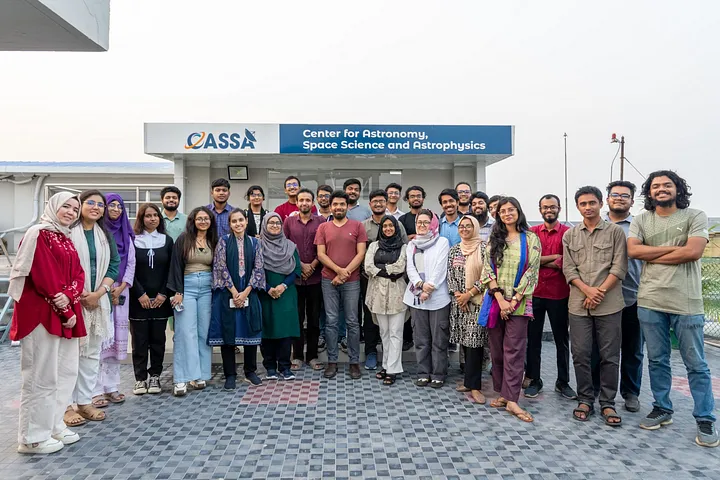
You can send your CV and SOP to Dr. Asad to work on any of the projects and if capable enough, you’ll be hired for an internship like I was. 😶🌫️ (continued)