My Research on Exoplanets and AI Won Three Minute Thesis Competition
Not long ago, my evening YouTube scroll was interrupted by an unexpected guest: It was a video of Emily Johnston presenting their research on mosquitoes in just three minutes. She explained her whole research so well such that it felt as if she were unveiling the mysteries of a forgotten world. For the first time I thought researching on mosquitoes can that be interesting.
Following the caption of that video, I found out, it was a competition named the Three Minute Thesis. It was founded at the University of Queensland in 2008, and now 3MT competitions are in place in over 900 universities in over 85 countries around the world.

Ever since witnessing that unforgettable 3MT presentation, I promised myself: if I ever made it to grad school, I wouldn't just write a thesis, I'd step onto a stage and tell others how interesting my research was. But I could hardly believe how quickly the opportunity found me.
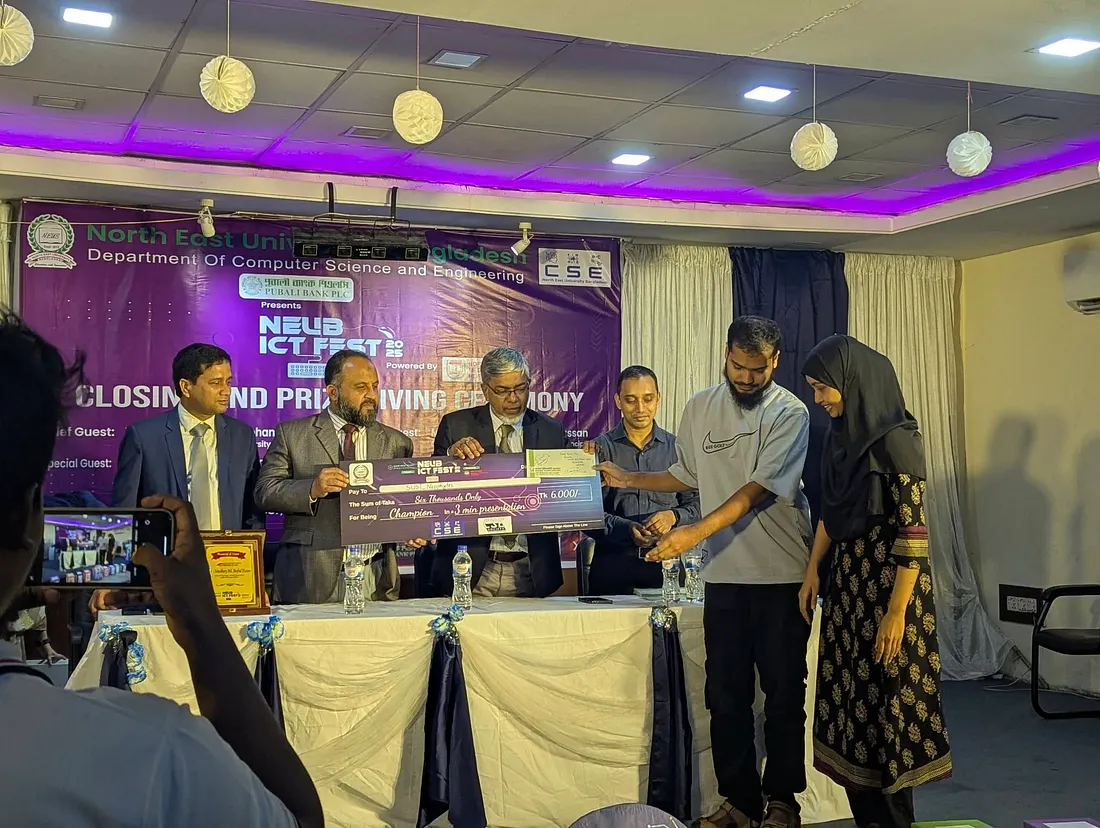
This year, North East University Bangladesh arranged the 3MT competition and invited undergrad students from different universities. My thesis on Exoplanet TTV Detection using Neural Nets was almost complete. So I thought, why not give it a try. I submitted my abstract to their website and Voilà it got accepted.
Here is my what I presented (and got the champion title)—
People have looked at the night sky for thousands of years. They have wondered: if there exists other planets like our Earth? In 1995, we found the first planet outside our solar system. Since then, we have discovered more than 6,000 such planets. These are called exoplanets.
Telescopes such as Kepler and TESS helped us find many exoplanets. They collect huge amounts of data. But manually searching for exoplanets through this huge amount of data is near to impossible. Machine learning can help by automating how we find these planets.
Some planets are hard to see. We cant catch them directly with telescopes. But they pull on bigger planets, changing the timing of their orbits. Astronomers call these changes “transit timing variations” or in short TTVs. TTVs are clues that a planet like our Earth might be hiding. Our research used neural networks to find these hidden planets.
How did we do that? We built two pipelines — one for Kepler data, one for TESS. Some of these hidden planets have already been found which we label TTVs. And some were already confirmed not to have any hidden planets which we label 'No TTVs'. Then we proceed to train our neural networks with this labeled data.
But there were problems: the dataset has a very small amount of TTV data compared with the other label.
To fix this imbalance, we used an algorithm called SMOTE. We also used a method called the K-folding
method to train and test our models with better stability.
We tried different neural networks such as MLP, RNN and CNN. For Kepler data, the CNN, the convolutional neural network performed best. It got 84% accuracy. For TESS data, the MLP, the multilayer perceptron did better. It reached 87% accuracy. The Kepler CNN model scores an ROC-AUC of 0.83, meaning it distinguishes transit signals from noise with high accuracy. The TESS MLP achieves 0.78, showing more than average reliability. Both results well exceed random chance, reflecting strong model performance for exoplanet detection.
It runs smoothly on a 8 GB RAM computer and the result is also promising. This will leverage the hunt for exoplanets and hopefully soon we'll find our Earth 2.0
I tried to make the sentences as simple as possible. Tried to break down the meanings of the jargon words. I tried to give the context of my research, what exoplanets are, why it is necessary, what was the research gap and how my work fits the gap.
I would like to acknowledge the contribution of two people here — Dr. Jerome de Leon of the University of Tokyo who was more than a mentor — he inspired me taught me how to hunt for distant worlds and never lose hope, even when the journey was hard. And my university supervisor — Dr. Md. Rasedujjaman, though new to astronomy, always believed in me and encouraged me to pursue what I love.